|
|
|
Natural Frequency and Resonance All structures vibrate/oscillate at some natural frequency. Each component of a generating set will vibrate at its natural frequency if a compatible frequency of excitation is applied to it. The prime mover (normally an internal combustion engine) driving the generator provides rotational and reciprocating forces which excite the whole assembly. If the vibrations excite resonance in the genset premature failure could occur. Vibration Forces A structure subjected to a vibrating force will experience cyclic displacement which can cause premature failure. If the movement of the structure is restricted the force will be transmitted to another area. This could result in premature failure in an area not directly associated with the original incidence. Vibration Technology Engineers study vibration, its effects and prevention methods in order to design out potential problems. However, problems can occur because several individually designed components are assembled together to form a new structure. Vibration technology has developed rapidly over recent years, We have been able to utilise this technology to help customers with vibration issues. Our assistance is often sought by generating set assemblers/suppliers and the end users. Machinery Health Monitoring One advantage that is offered to our customers is the ability to have a new set design verified by vibration analysis. This will prove the design criteria and provide a base line signature for use during routine periodic machinery health monitoring. We advise all customers to monitor the health of the generating set using vibration monitoring equipment. Services Offered Newage AVK SEG have the facilities for measuring the following parameters:-  Check generator set compliance with ISO 8528/9 and DNV recommendations.
Check for out of balance, misalignment, mechanical looseness, etc using
FFT spectrum and phase analysis
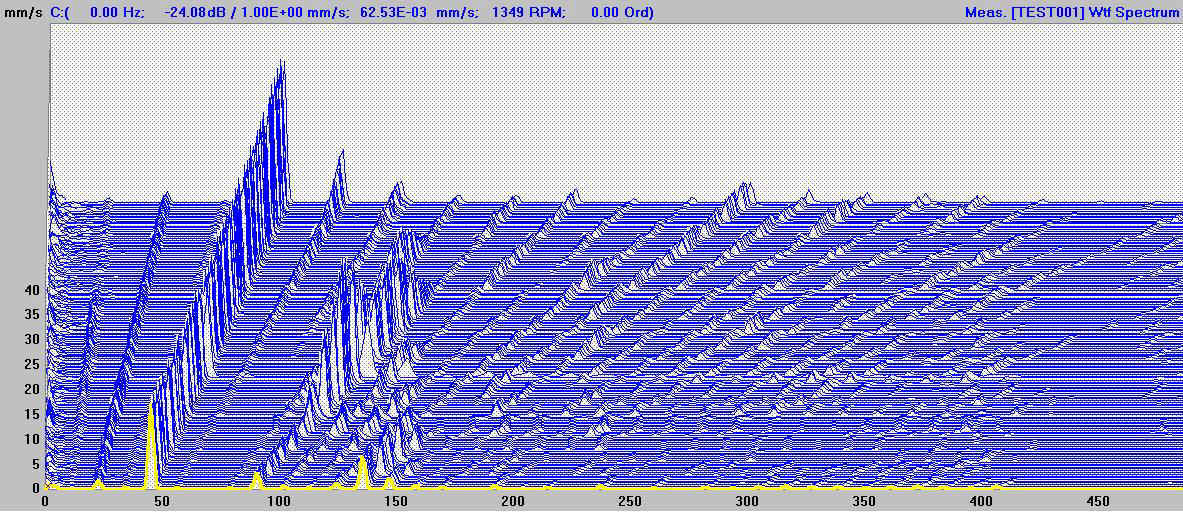
Check for shaft critical speeds and structural resonance’s using Order
Tracking, Waterfall Polar or Nyquist Plots. Check generator set compliance with ISO 8528/9 and DNV recommendations.
Check for out of balance, misalignment, mechanical looseness, etc using
FFT spectrum and phase analysis
Check for shaft critical speeds and structural resonance’s using Order
Tracking, Waterfall Polar or Nyquist Plots.
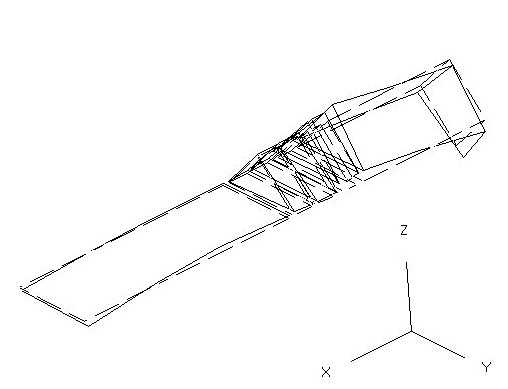
Operating Deflection Shape (ODS) can be achieved
by collecting data at specific locations around the structure of interest. Visual representation of the animated structure aid dynamic analysis. The ideal analysis is carried out at the generators normal operating conditions.
(Use the above two images from the Product guide CD issue2) Modal Analysis data can be used to fully analyse and solve structural
dynamic problems. This technique can beused to separate natural frequency mode shapes from overall dynamic response of the structure.
Time-Domain analysis data can be used to animate the structure over a
period of time. Time-domain analysis is uniquely suited for transient, nonlinear, or frequency-variant events. For example, machine ‘run-up/coast-down’, shock response or dynamic changes in mass, stiffness or damping during measurement periods. A full report of each analysis is supplied in 'WORD' |
|
If in doubt or you need more information consult our website, www.newage-avkseg.com - alternatively contact the UK factory direct. Barnack Road, Stamford, Lincoinshire, PE9 2NB, England, UK. Tel 44 (0) 1780 484000 . Fax 44 (0) 01780 484100. info@newage-avkseg.com © 2002 Newage International Ltd. 'STAMFORD' is a registered trademark of Newage International Ltd. Note that the pictures used on this CD are only representative of the generator range.
|